Every cyclist asks this question, whether they’re a seasoned racer or a weekend warrior: how many calories does cycling a mile burn?
It sounds like a simple math problem, right? You cycle one mile, your fitness app gives you a number, and you move on. But here is the truth: that number is almost always wrong. Relying on an inaccurate calorie count can be frustrating, especially if you’re riding for weight loss or performance goals.
The reality is that the energy required to propel yourself and your bike one mile is never a fixed number. It’s a dynamic calculation involving physics, biology, and even the weather.
In this definitive guide, we’ll cut through the guesswork and show you the average burn, why your unique factors matter, and how to get the most accurate count every time you clip in.
The Quick Answer: What is the Average Calorie Burn?
If you just need a starting point; the number that applies to most recreational riders, here it is:
The average person burns between 40 to 100 calories per mile while cycling.
That range is wide for a reason, but to give you a solid, reliable benchmark for a typical, moderate ride:
A 150-pound (68 kg) rider traveling at a consistent speed of 15 mph (24 kph) on flat, paved terrain will burn approximately 65 calories per mile.
This benchmark is critical. If your ride falls outside the “average,” you’ll either be at the lower end (e.g., a lightweight rider coasting slowly downhill) or the higher end (e.g., a heavier rider sprinting uphill).
To understand where you fall on this spectrum, you need to look at the four major forces that dictate your energy expenditure. These four factors are what can quadruple your burn rate from one mile to the next:
- Body Mass: How much weight you and your bike have.
- Speed and Intensity: How fast you are pedaling against resistance.
- Terrain and Elevation: Whether you are fighting gravity or rolling freely.
- Equipment and Environment: Everything from your tires to the wind.
The Science of Calorie Burn: Why the Number Changes
You are essentially a machine converting chemical energy (calories) into mechanical energy (motion). The total work you have to do is dictated by how much resistance you overcome. Let’s dive into the two biggest levers you can pull to change the answer to “how many calories does cycling a mile burn.”
Factor 1: Body Mass and Composition (The Biggest Lever)
When you look at the basic physics of cycling, your body weight is the single most important variable for cycling calorie burn by weight. It takes significantly more energy to move a larger mass a certain distance.
Think about it like this: your legs must push harder against the pedals to accelerate and maintain the speed of a heavier combined weight (you + the bike). This is especially true when you’re climbing, where you are directly fighting gravity.
For a fixed distance (one mile) and a fixed speed, a person who weighs more will burn a higher number of total calories. However, that doesn’t mean they’re working harder relative to their size; it just means the absolute energy requirement is higher.
Here is how the calorie burn per mile changes based on body weight, assuming you maintain a moderate effort of 15 mph on flat ground:
| Body Weight | Weight (kg) | Estimated Calories Per Mile (at 15 mph) |
|---|---|---|
| 120 lbs | 54 kg | 52 Calories |
| 150 lbs | 68 kg | 65 Calories |
| 180 lbs | 82 kg | 78 Calories |
| 210 lbs | 95 kg | 91 Calories |
Factor 2: Speed and Intensity (Power Output)
If body mass is the most important factor for how many calories does cycling a mile burn in general, speed is the most important factor you can control to boost your burn.
The relationship between speed and energy output is not linear, it’s exponential. This means that if you double your speed, you more than double your effort. Why?
The main culprit is air resistance, or drag. At slow speeds, drag is barely noticeable, but once you push past about 12 mph, drag quickly becomes the single biggest force you are working against. To move from 15 mph to 20 mph, you have to generate a disproportionately large amount of extra power just to carve through the air.
This is why focusing on your speed is the best way to maximize your energy usage on flat terrain.
| Intensity/Speed | Speed (kph) | Estimated Calories Per Mile (150 lb rider) |
|---|---|---|
| Casual (10 mph) | 16 kph | 52 Calories |
| Moderate (15 mph) | 24 kph | 65 Calories |
| Intense (20 mph) | 32 kph | 83 Calories |
| Sprint (25 mph) | 40 kph | 108 Calories |
As you can see, a rider pushing an intense 20 mph burns nearly twice the calories of a leisurely rider covering the same mile at 10 mph. Understanding this key principle of cycling calorie burn per mph is essential for effective training.
Factor 3: Terrain and Elevation (Fighting Gravity)
You know this instinctively: climbing a hill is dramatically harder than riding on a flat road. This is where the energy cost of cycling skyrockets.
When you climb, you are fighting two things: air resistance (as mentioned above) and the constant pull of gravity. On a flat mile, most of your energy goes into overcoming rolling resistance and air resistance. On an uphill mile, a huge percentage of your effort goes into gaining vertical height (potential energy).
This factor is also where the wind comes in.
- The Calorie Cost of Climbing: A short, steep hill on your route can easily push your average how many calories does cycling a mile burn number into the 80–120 calorie range for that specific mile. It’s an efficient way to boost your burn without riding faster.
- Headwind vs. Tailwind: The wind is an invisible force multiplier. A stiff headwind can feel exactly like riding uphill, it forces you to push more watts just to maintain speed. Conversely, a tailwind or drafting behind another rider dramatically reduces the effort needed, lowering your total calorie burn significantly.
Factor 4: Equipment and Environment
While not as impactful as your body weight or speed, your gear and environment still play a role in the final calculation. The more efficient your setup, the less energy you “waste” on friction, and the less you burn per mile traveled.
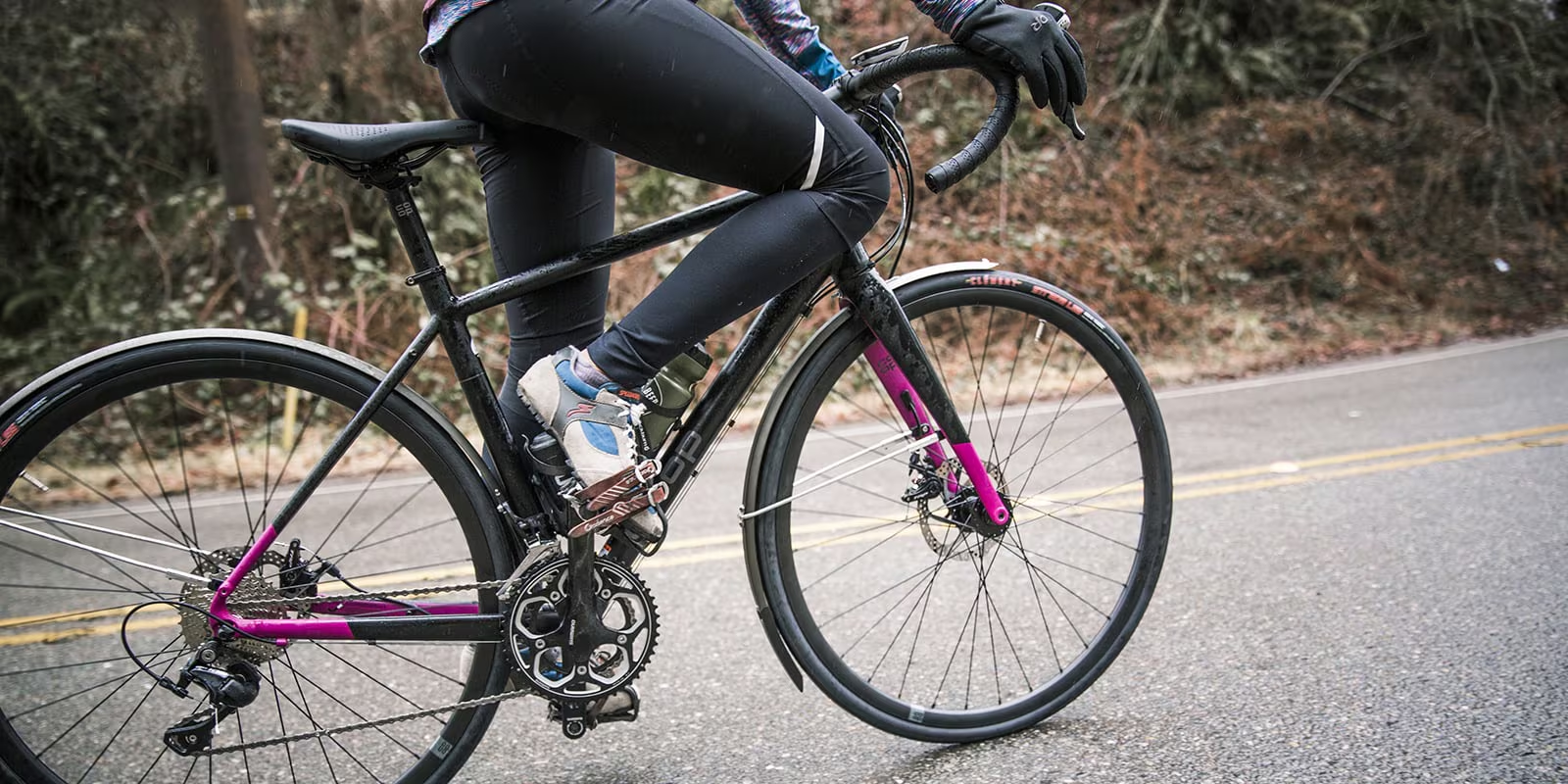
- Bike Type: A lightweight road bike with thin, high-pressure tires has minimal rolling resistance compared to a heavy mountain bike with knobby, wide tires. You will burn fewer calories per mile on the road bike simply because the mountain bike requires more effort to turn its wheels and overcome tire friction.
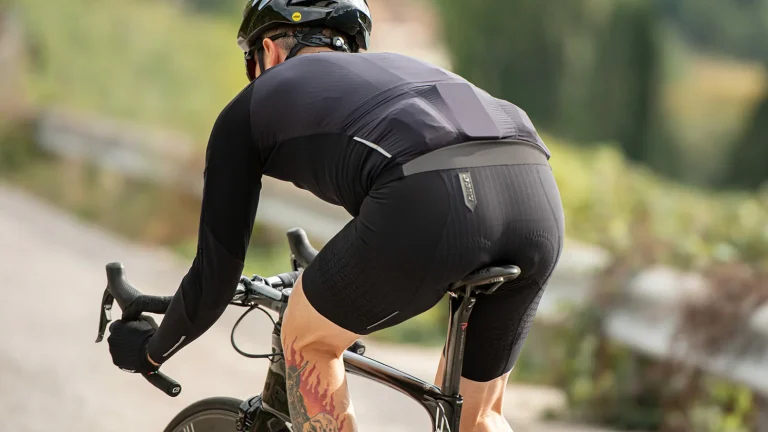
- Tire Pressure and Clothing: Under-inflated tires create more friction against the road, forcing you to burn more to maintain speed. Similarly, wearing loose, baggy clothing increases your overall aerodynamic drag, forcing you to expend more energy to push that mile. Cyclists wear tight-fitting jerseys not just for style, but to minimize this energy cost.
Practical Application: How to Calculate Your Exact Burn
Getting a precise answer for how many calories does cycling a mile burn requires moving beyond simple calculators and using real data. The formula below gives you the most scientifically accurate estimate available, and is the basis for how the best cycling computers track your ride.
The METs Formula Explained (For True Accuracy)
The gold standard for estimating calorie expenditure uses the Metabolic Equivalent of Task, or METs. A MET value represents the ratio of your working metabolic rate to your resting metabolic rate. In simple terms, 1 MET is the energy you expend sitting still; 8 METs means you are working 8 times harder than when you are resting.
The formula is:Calories Burned=MET×Weight (kg)×Time (hours)
You need to know your weight, the duration of the ride, and the appropriate MET value for your intensity.
| Cycling Intensity | MET Value | Example |
|---|---|---|
| Leisurely Pace (Casual) | 4.0 METs | Riding a beach cruiser or gentle path, <10 mph |
| Moderate Pace (Commuting) | 6.8 METs | Consistent pace with some effort, 10−14 mph |
| Vigorous Pace (Training) | 8.0 METs | High-intensity sustained effort, 14−16 mph |
| Racing/Sprinting (Max Effort) | 12.0 METs | Fast group ride or a time trial, >20 mph |
Example: If a 68 kg rider takes 20 minutes (or 0.33 hours) to complete 5 miles at a vigorous pace (8.0 METs):
Calories Burned=8.0×68 kg×0.33 hours≈179.5 calories totalCalories Per Mile=179.5/5 miles≈35.9 calories per mile
Note: This specific example shows a lower calorie burn per mile than the average range. This is because the MET formula often provides a lower, more accurate baseline, while general calculators over-estimate.
Recommended Tracking Tools
If you don’t want to calculate METs by hand, you should rely on technology that captures your personal data.
- GPS Devices (Garmin, Wahoo): These track your distance, time, and, crucially, your elevation gain. Most modern GPS computers factor your estimated weight and the terrain into their calorie algorithms, offering a much better estimate than a phone app relying on speed alone.
- Heart Rate Monitors (HRM): An HRM provides a personalized, real-time burn estimate. Your heart rate is a good proxy for effort. By measuring how hard your cardiovascular system is working, the HRM can use your age, weight, and max heart rate to give a highly personalized estimate, far superior to generic calculations.
- Power Meters (The Gold Standard): If you are truly serious about precision, a power meter is the only way to measure your calorie expenditure with near-perfect accuracy. A power meter measures the true mechanical work you are putting into the pedals in Joules. Since 1 Food Calorie is equal to approximately 4.184 Joules, the conversion is straightforward. This metric is independent of terrain, wind, or weight, measuring the energy you actually produced.
Cycling Calorie Burn vs. Other Activities

Understanding how many calories does cycling a mile burn is much easier when you compare it to other popular endurance activities. The main takeaway here is efficiency: cycling is a low-impact activity, which changes how your body uses energy.
Cycling 1 Mile vs. Running 1 Mile (The Key Comparison)
This is perhaps the most common comparison, and it highlights a fundamental difference between weight-bearing and non-weight-bearing exercise.
| Activity | Estimated Calories Per Mile (150 lb person) | Why the Difference? |
|---|---|---|
| Running (10 min/mile pace) | 100−120 Calories | Running is weight-bearing. You lift your entire body weight with every stride, forcing high vertical energy expenditure. |
| Cycling (15 mph pace) | 60−70 Calories | Cycling is non-weight-bearing. You are supported by the saddle, minimizing impact and vertical movement. Most energy is spent overcoming wind and friction. |
The Analysis: Running almost always burns more calories per mile than cycling. However, this is misleading. Because cycling is low-impact, you can typically sustain a much longer workout, go much faster, and recover quicker.
The Equivalent Effort: The 3:1 Mile Rule
To equal the calorie burn of running one mile, you generally need to cycle about three miles.
This is a useful rule of thumb for cross-training. If your running workout calls for a 5 mile run, the equivalent calorie-burning cycling workout would be approximately 15 miles. Cycling may burn fewer calories per mile, but it lets you cover distance and duration efficiently and safely.
Other Common Comparisons (Briefly)
- Cycling vs. Walking: Cycling at any moderate speed will burn significantly more calories per mile than walking, simply because the speed and resistance are much greater.
- Cycling vs. Swimming: Swimming is often a comparable, or even higher, calorie burner than intense cycling, as you are working every major muscle group and overcoming the resistance of water.
Maximizing Your Calorie Burn (Actionable Tips for Weight Loss)
If your goal is weight loss, you want to push that how many calories does cycling a mile burn number as high as possible. Here are three expert tips on how to structure your rides to maximize total energy expenditure.
Incorporate High-Intensity Interval Training (HIIT)
The best way to turn your body into a fat-burning machine is to confuse it. Instead of riding at a steady, moderate pace for an hour (Zone 2), incorporate periods of near-maximum effort.
- How it works: Sprint for 30 seconds, then recover at an easy pace for 60 seconds. Repeat this 8−10 times.
- The Benefit: HIIT creates a phenomenon called EPOC (Excess Post-exercise Oxygen Consumption), or the “afterburn” effect. Your body continues to burn calories at an elevated rate for hours after you get off the bike as it works to repair muscles and restore oxygen levels.
Attack the Hills
This is the simplest tactic. When you encounter a hill, don’t just shift down and spin, get out of the saddle and push.
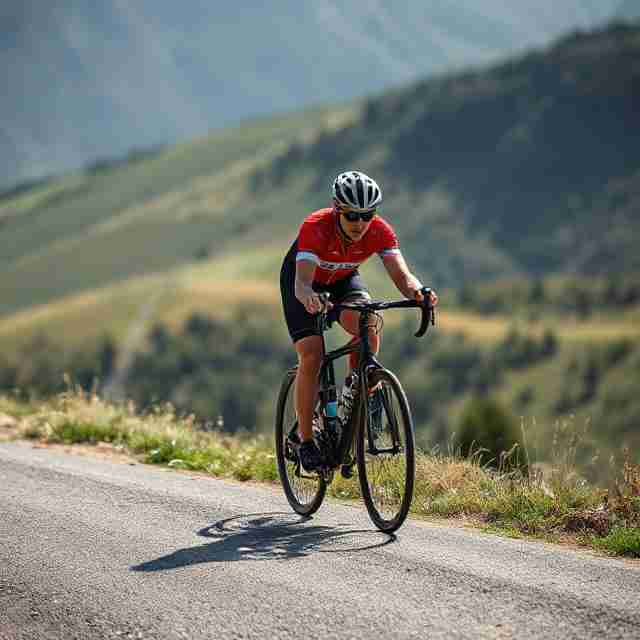
Climbing engages major muscle groups, particularly your glutes and hamstrings, in a way that flat riding often doesn’t. Since climbing is a direct fight against gravity, your power output (and therefore your calorie burn) spikes dramatically, ensuring a higher calorie cost for that mile. Look for routes with significant elevation gain to get the best return on your time investment.
Strategic Under-Fueling (For Zone 2 Training)

Disclaimer: This strategy should only be attempted by experienced riders who are familiar with their body’s limits. Always carry sufficient emergency nutrition.
If you ride at a lower, conversational intensity (Zone 2 heart rate or power zone), your body prefers to burn fat for fuel. To encourage this process further, some athletes perform a “fasted ride.”
- How it works: Ride first thing in the morning before eating breakfast, or ride a couple of hours after a low-carb meal. With carbohydrate stores low, your body is forced to tap directly into fat stores for energy, maximizing fat oxidation during the ride. Keep these rides under 90 minutes and keep the intensity moderate to avoid “bonking” (running out of fuel).
Frequently Asked Questions (FAQ)
We’ve covered the complexity of the calculation, but here are the quick answers to the most common questions riders have about calorie burn.
How many calories burned cycling 10 miles?
Based on our average range of 40−100 calories per mile, a 10 mile ride would burn between 400 and 1,000 total calories.
A realistic, moderate 10 mile ride for a 150 lb person at 15 mph (burning 65 calories/mile) would equal 650 calories. This is a solid, measurable workout.
Is cycling 1 mile a day enough for weight loss?
While every mile counts, cycling 1 mile a day is likely not enough to create a significant calorie deficit for weight loss on its own. Since 1 mile only burns about 50−100 calories, you would need to cut that amount from your diet just to break even.
Weight loss is primarily achieved through a sustained calorie deficit. The greatest value of cycling one mile a day is the consistency it builds and the habit it creates. Increase your mileage or intensity over time, and pair it with a healthy diet, and you will certainly see results.
Do e-bikes burn calories?
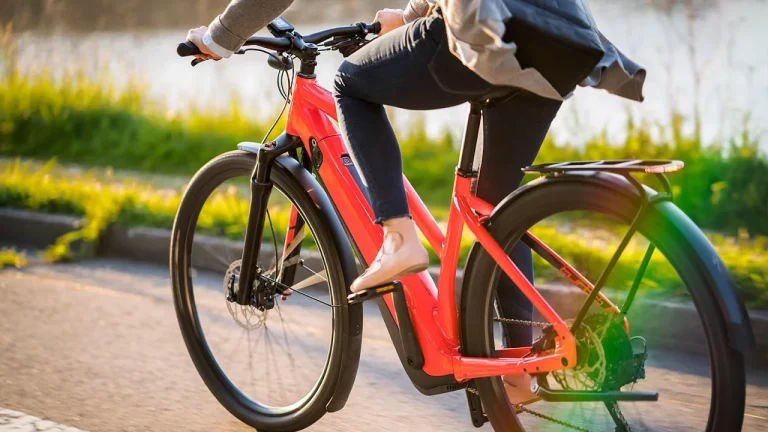
Absolutely, e-bikes burn calories, though generally fewer than a conventional bike over the same distance. The calorie burn depends entirely on the level of pedal assist you use. If you use a high-assist mode (Turbo), your effort is minimal. If you keep the e-bike in a low-assist mode or turn the motor off, your calorie burn will be very close to a traditional bike, as you are still moving the combined weight of yourself and a heavier machine.
Does cycling burn belly fat?
No specific exercise can magically target and burn belly fat, this is a myth known as “spot reduction.” When you exercise, your body loses fat from all over.
However, cycling is a phenomenal tool for overall fat loss. If you consistently burn more calories than you consume, your body will reduce its total fat percentage, and that will include the fat stored in your abdominal area. Long, steady rides (Zone 2) are particularly effective at encouraging your body to utilize fat stores for energy.
Conclusion: Consistency is the Real Calorie King
When you set out to determine how many calories does cycling a mile burn, remember that the answer is less a fixed number and more a dynamic result of your personal effort. The precise number is less important than the overall trend.
The difference between a 40 calorie mile and a 100 calorie mile is the effort you put in. By increasing your speed, seeking out hills, and utilizing high-intensity intervals, you directly manipulate the physics and maximize your burn.
But the most effective tool in your fitness arsenal will always be consistency. A moderate 10 mile ride four times a week will always yield better results than one strenuous 50 mile ride every month. Keep riding, stay consistent, and the numbers, whether 50 or 100 calories, will take care of themselves. Enjoy the road!
About the Author